• About
  • News
  • Recordings
  • Media
    • Gallery
    • Videos
    • Podcasts
  • Contact

News

Why Cramer’s Piano Quintets Deserve to Be Played Again – Preparing Piano Quintet No. 3, or Why Good Manners Ruined His Career

January 20, 2026 by luismagalhaes.com
Conway hall, cramer, I Musicanti, Piano

Johann Baptist Cramer had a serious problem. He was excellent at everything he did.

He was admired by Beethoven. He was one of the most respected pianists in Europe. He wrote music that fits the hands, makes musical sense, and does not collapse under pressure. Naturally, history responded by quietly ignoring most of it.

Johann Baptist Cramer is remembered today almost exclusively for piano studies. This is like remembering Ferrari solely for the spare parts catalogue. Useful, yes. But it misses the point.

Cramer’s Piano Quintets suffer from a fatal flaw in modern concert life. They behave. They do not scream. They do not posture. They do not attempt to impersonate an orchestra while the strings cling on for dear life. They assume that everyone involved knows what they are doing. This assumption alone has kept them out of the repertoire.

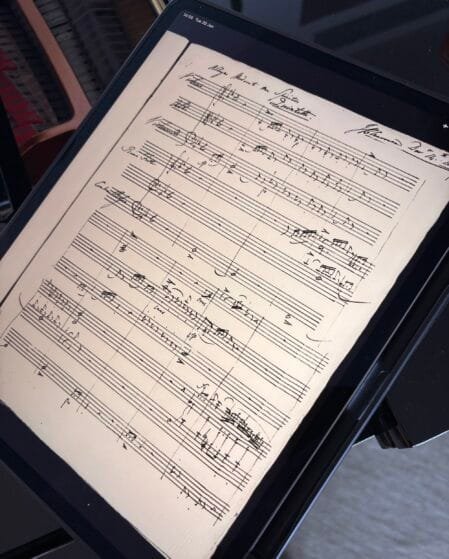
Piano Quintet No. 3 is a masterclass in proportion. The piano part is busy, articulate, and beautifully written, but it is never allowed to become the centre of the universe. This is not a concerto with string decorations. This is chamber music. The piano is expected to listen. To blend. To occasionally shut up. An outrageous demand.

On a modern concert grand, this becomes immediately uncomfortable. The instrument is large, powerful, and keen to help whether you asked for it or not. Cramer did not write for this. He wrote for clarity. Which means the pianist must spend a considerable amount of time doing less. Less pedal. Less sound. Less self-expression. More judgement.

This is harder than it sounds. The piece has no patience for interpretive freelancing. It rewards precision and punishes optimism. And yet, when done properly, the music is deeply satisfying. It has wit without punchlines. Charm without flattery. Confidence without noise. An approach that, if applied more broadly, would solve many problems.

For audiences, I am curious about the effect it might have. I wonder if they will listen, follow lines or hear conversation rather than competition.

So why is Cramer rarely played. Because he sits in the wrong place historically. Too late to be purely Classical. Too early to indulge in Romantic excess. Too well balanced to fit the modern appetite for extremes. He does not fit a narrative. He fits music.

Cramer’s Piano Quintet No. 3 will be performed on 15 February at Conway Hall, London, in a programme that unintentionally proves the point. Beethoven’s Piano Quartet Op. 16 opens with elegance and a sense of humour sharp enough to survive two centuries. Cramer follows, reminding everyone that good writing does not need to announce itself. Schubert’s “Trout” Quintet closes the evening by cheerfully ignoring all restraint and getting away with it.

Programme
6.30pm
Beethoven. Piano Quartet in E flat Op. 16
Cramer. Piano Quintet No. 3 in B flat Op. 79
Schubert. Quintet in A major “Trout” D 667

Performers
Martyn Jackson. violin
Robert Smissen. viola
Ursula Smith. cello
Leon Bosch. double bass
Luis Magalhães. piano

Cramer does not need rescuing. He needs performers willing to play what is written, listeners willing to pay attention, and a general reduction in unnecessary drama.

Which, admittedly, makes him a difficult sell. Come join us! Tickets here.

Gaia Festival, Thun. Or: How Having Nothing To Do Became My Greatest Achievement

December 1, 2025 by luismagalhaes.com
atelier, frank's, gaia, thun

I went to the Gaia Musikfestival in Thun with a shocking amount of free time.

This is unusual for a music festival. Normally you are busy. Rehearsing. Stressing. Pretending to be busy while scrolling your phone with purpose.
Not here.

Here, I had time.
Glorious. Swiss. Uninterrupted time.

So did Casper Vos.

This was dangerous.

Two pianists. Partners at home. Minimal responsibilities. A picturesque town. This is how stories begin that end with someone saying, “We should not tell anyone about this.”

Naturally, we found Atelier.

Atelier is not a cocktail bar that wants attention. It does not wave menus. It does not lecture you about ice. It does not describe drinks using words like “journey” or “forest floor”.
It simply sits there, confident, like a bar that knows you will eventually give in and loose whatever dignity you have left.

Inside, bottles line the walls in a way that suggests expertise, mild chaos, and excellent life choices. The lighting makes everyone look like a better version of themselves. This is suspicious and should probably be regulated.

Then came Frank’s Ingwer.

Frank’s Ingwer is not subtle. It does not ease you in. It announces itself like a friendly slap. Ginger with opinions. Ginger with posture. Ginger that makes you say, “Oh. So that is how that is supposed to taste.” She introduces herself, “Oh HI! I am Ginger! You come here often??”.

Atelier, to its credit, does not interfere. They do not overthink it. They serve it like responsible adults who trust ingredients and their customers. A radical concept.

Evenings followed a clear structure.

Arrive.
Sit down.
Order something sensible.
Immediately order something less sensible.

Conversations drifted freely, mostly because neither of us had anything urgent to escape to. Music was discussed. Life was discussed. Absolutely nothing was discussed at length and with great enthusiasm.

This is the underrated luxury of festivals when you are not overbooked. You are not “on”. You are off. You exist. You laugh. You realise you are a human and not a scheduling problem.

Meanwhile, Thun continued being aggressively beautiful. Mountains. Silence. Viola players. As if the town itself was judging you gently but firmly.

By the end of the week, I had learned several things.
First. Good festivals are defined by what happens offstage.
Second. Free time is a gift and should be handled carefully.
Third. Frank’s Ingwer should be exported worldwide immediately.
Fourth. Pianists with nothing to do are extremely cheerful and mildly dangerous.

I came to Thun for music.
I stayed upright because Switzerland is efficient.
And I will return knowing exactly where to go when there is nothing to do again.

Magalhães & Thedéen

September 8, 2025 by luismagalhaes.com
chambermusic, livemusic, pianistlife

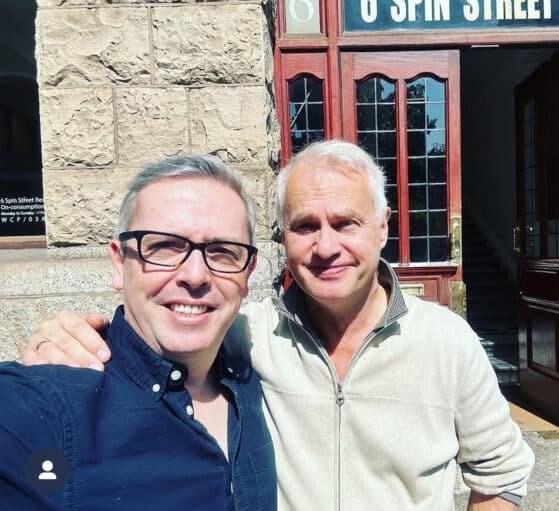
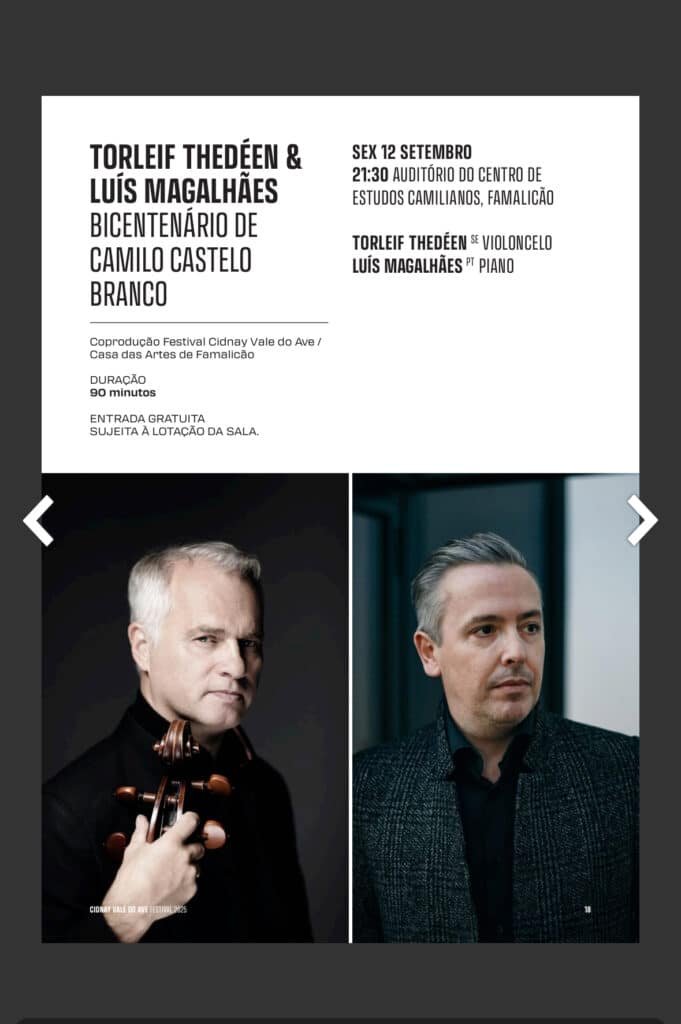
Torleif and I are playing two evenings of music that speak to both nostalgia and deep emotion. From the dreamlike Janáček to the lyrical Schubert songs I’ve always loved. This program has been a joy to prepare. Rearranged works originally written for violin take on a new voice through the cello, and Brahms is, as always, the anchor. Famalicão and Coimbra: see you soon!

Cidnay Festival: https://cidnayfestival.com
Coimbra: https://tagv.pt/agenda/torleif-thedeen-luis-magalhaes-ecos-do-romantismo-recital-de-violoncelo-e-piano/

Mozart, Beethoven, Schubert, Brahms

May 9, 2025 by luismagalhaes.com
Arda Records, Artway Management, Beethoven Op. 125, Brahms Op. 119, Casa da Música event, CD release 2025, classical music CD release, classical music concert, Gerhard Roux sound engineer, live classical music, Luis, Mozart Fantasies, music events in Porto, Porto concerts, Schubert Sonata, Yamaha Artists Services, Yamaha piano

Luis Magalhães releases on 13 May 2025 a new album dedicated to the masters of the European tradition.

A dialogue with the masters!

In his most recent recording, pianist Luís Magalhães invites us on a journey through the universe of four of the most iconic composers in the piano tradition: Mozart, Beethoven, Schubert and Brahms. With the sensitivity and interpretative mastery that distinguish him, Magalhães builds a bridge between the expressive worlds of these geniuses, revealing both the continuity and contrast in their musical languages—from Mozart’s luminous clarity to Brahms’s romantic density. In each interpretation, he demonstrates profound respect for the spirit of the score, while also imprinting a personal vision that enriches the listening experience and renews the music for the audience.

Tracklist

CD 1

Schubert: 3 Klavierstücke, D.946

1          I. Allegro assai 10:23

2          II. Allegretto 13:38

3          III. Allegro 5:16

Schubert: Sonata in B-flat major, D.960

4          I. Molto moderato 20:40

5          II. Andante sostenuto 10:26

6          III. Scherzo. Allegro vivace con delicatezza — Trio 3:59

7          IV. Allegro ma non troppo 8:38

CD 2

1          W. A. Mozart: Fantasia in D minor, K.397/385g 6:56

2          W. A. Mozart: Fantasia in C minor, K.475 14:25

L. v. Beethoven: 6 Bagatelles, Op.126

3          I. Andante con moto, cantabile e con piacevole 3:59

4          II. Allegro 3:11

5          III. Andante, Cantabile ed espressivo 3:08

6          IV. Presto 4:15

7          V. Quasi allegretto 2:57

8          VI.Presto — Andante amabile e con moto 4:12

J. Brahms: 4 Klavierstücke, Op.119

9          I. Intermezzo: Adagio 4:01

10        II. Intermezzo: Andantino un poco agitato 5:00

11        III. Intermezzo: Grazioso e giocoso 2:10

12        IV. Rhapsodie: Allegro risoluto 4:58

Recent Posts

  • Why Cramer’s Piano Quintets Deserve to Be Played Again – Preparing Piano Quintet No. 3, or Why Good Manners Ruined His Career
  • Gaia Festival, Thun. Or: How Having Nothing To Do Became My Greatest Achievement
  • Magalhães & Thedéen
  • Mozart, Beethoven, Schubert, Brahms
  • Get Ready to Party Like It’s 1799! CD Release Concert at Casa da Música

Recent Comments

    Archives

    • January 2026
    • December 2025
    • September 2025
    • May 2025
    • February 2025
    • January 2025

    Categories

    • Events
    • News
    • Stories

    Copyright © 2026 Luis Magalhães – All rights reserved